
Human Rights & Democracy
Podcasting from the West Bank with “This American Life”
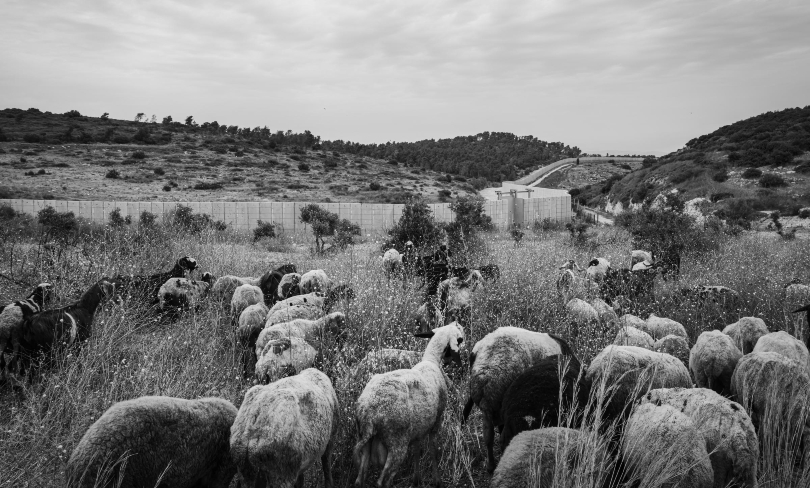
Photo Credit: Sakir Khader / Magnum Photos
Last week, the long form podcast This American Life hosted by Ira Glass released an episode titled “The Other Territory.” It was a deep dive into some of the more dramatic changes Israel has imposed on the West Bank since the start of the war in Gaza nearly two years ago. “So much has gotten worse in the West Bank since October 7 for Palestinians—more violence, more of them driven off their land,” Glass reported. “Israel’s actions right now in the West Bank seem to have two goals—to crush the idea that a Palestinian state will ever be there and, as Smotrich wrote in 2017, to drive Palestinians to cross the threshold of despair.”
The first full segment of the episode walks the listener through a day in the life of Ali Awad, a young man living in a village in Masafer Yatta called Tuba. Masafer Yatta is the hamlet of 19 villages where No Other Land was filmed and where Awdeh Al-Hathaleen, the school teacher and nonviolent activist, was recently murdered by a violent settler. The story illustrates just how much more violent and aggressive settlers have become since October 7, drawing on statistics from NIF partners like Peace Now and grantees like Yesh Din.
Our grantees and partners on the ground in Masafer Yatta have long been speaking out about the military’s increasing use of movable checkpoints and roadblocks. In a place like Tuba, which has only one road going in and out, this kind of roadblock effectively restricts residents’ movement to and from their tiny village. In addition, more settlers, our partners have made clear, have been coming into Palestinian villages dressed in IDF uniforms. And they’ve been saying—with frustrated repetition—that these settlers are emboldened, knowing that a wide swath of government ministers have their back. Yisrael Katz, Israel’s Defense Minister, has leveraged the army to make Palestinian life more difficult as well. Back in February, Katz announced that the military was going to start using the same tactics in the West Bank that they’ve been using in Gaza to level houses and neighborhoods. In mid-August, Minister Bezalel Smotrich said he was “burying” the idea of a Palestinian state.
The second segment of the This American Life episode tells the terrible, powerful tale of a 17-year-old Palestinian from the West Bank named Walid Ahmad, who died recently while being detained in Israeli prison for allegedly throwing a molotov cocktail (though the military was extremely vague about the evidence). In the episode, a board member of NIF grantee, Physicians for Human Rights – Israel (PHRI) attends Walid’s autopsy, because the military will no longer allow Palestinian physicians to attend. They found that he had died of a treatable infection, a condition likely exacerbated by acute malnutrition. Palestinian prisoners have faced “food reduction” policies since October 7, enacted by Minister of National Security Itamar Ben-Gvir, who controls the Israel Prison Service (IPS). The results have had devastating effects on prisoners’ health. Walid was the first minor to die in custody, but he was not the first prisoner. According to ACRI, prisoners have shed an extraordinary amount of weight under the policy—up to 40 kg—a loss which amounts to evidence of starvation. In one testimony, a diabetic prisoner described eating toothpaste to raise his blood sugar.
NIF and our grantees have been working to block Ben Gvir’s policies since their implementation. Months ago, the Association for Civil Rights in Israel (ACRI) filed a petition challenging the legality of his “food reduction” policy under both international and Israeli law, both of which prohibit starving prisoners, regardless of the crimes they’ve committed. When the hearing was held, Ben Gvir himself showed up, and announced that he found the notion of even discussing prisoners’ rights absurd. He called the hearing an exercise in “madness and delusion” and said that he was there “to ensure that the ‘terrorists’ receive the minimum of the minimum (in food).”
All of the difficulty and suffering that Palestinians have endured under occupation has tripled and quadrupled since October 7. But NIF and its grantees are not giving up. We will continue to run our activist support program in Masafer Yatta. We stand with Palestinians, offering them “protective presence” against soldiers, settlers, and settlers dressed as soldiers, whenever possible, and resisting the atmosphere of fear that pervades their villages. We will follow Yesh Din’s lead as they offer updated statistics on settler violence, undergirding the effort to bring a modicum of justice to Palestinians. We will continue to support PHRI’s sacred work helping people like Walid’s family, the value of which it is impossible to measure. And, as always, we will continue to support the activists at places like ACRI who do the hard work of demanding that Israeli courts, the Israeli state, and all of its executive bodies work for the wellbeing of its weakest members. Because Israeli society—like any society—is only as strong as its most marginalized.