Human Rights & Democracy
Documenting the Journeys of Women Working for a Better Reality
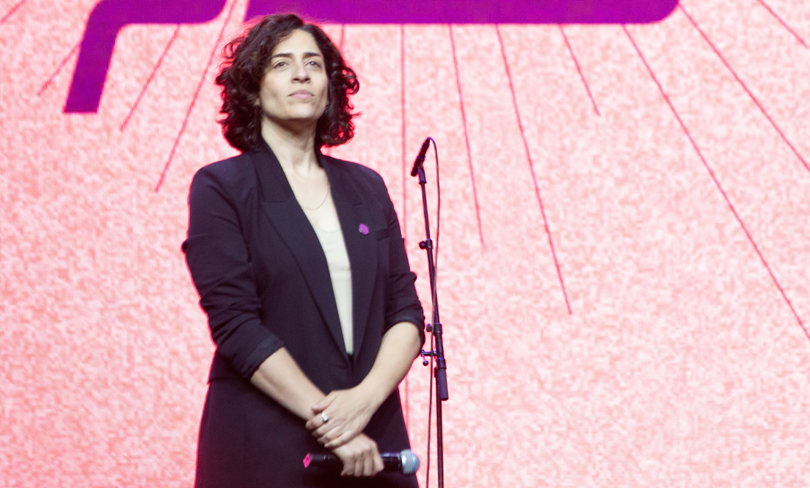
Inspired by the memory of Vivian Silver, a long-time peace activist who was murdered on October 7, 2023, a group of activists came together to document the life stories of 21 women, Jewish and Arab, each working in her own way to reshape reality and insist on peace.
Below is an excerpt from the book they created together, Women Write Hope. It is an interview by Galit Pnina Avinoam with Rula Daood, national co-director of Standing Together and a Palestinian citizen of Israel.
To read the rest of this remarkable collection, you can purchase the book here.
—
Rula’s Story: Standing Together and Not Giving up
Interviewed by: Galit Pnina Avinoam
Rula Daood is the national co-director of Standing Together, a political movement comprising Jews and Arabs that advocates for peace, justice, and equality. We met at the movement’s headquarters in south Tel Aviv. The office was full of busy young men and women. Rula explained that everyone was currently working around the clock on the aid campaign for Gaza – an initiative of the movement, which had already collected 350 truckloads of donations. Our meeting was interrupted several times by urgent telephone conversations with embassies,
media outlets, and other contacts. I asked Rula to set aside a bit more time with me, and to my delight we scheduled another meeting a few days later at her home in Jaffa.
—
Rula is 39. She looks younger. From the moment we meet, I am struck by how similar she looks to one of my nieces. Throughout the interview, the words “leader” and “together” feature prominently, as Rula tells the story of a girl who grew up in Kafr Yasif, an Arab village in the north of Israel. Alongside reminiscences of a happy childhood, Rula also shares family stories surrounding the expulsion in 1948, “when the Jews arrived.” She speaks of a grandmother hiding in a cave and of parents who didn’t want politics at home. Something of a villager’s pride still sparkles in her eyes when she talks about her family.
Rula recounts:
I come from a middle-class family that lived in Kafr Yasif. We lived in one of the higher neighborhoods of the village, which was relatively new and didn’t have many houses. I remember Grandma cooking the rabbits that used to roam in the yard. When we found out, we stopped eating meat at her place. Academic achievements were very important to my parents. I left home to work at a young age. At 15, I moved in with my aunts and uncles in Jaffa and worked screening matriculation exam papers. My father was a secretary at the village high school and arranged the job for me. But my dream was to become a film director – I wanted to tell stories. As a child, I would write scripts for myself. I loved fantasy and science fiction and read a lot, mostly in English. When I shared my ambition with my father, he told me: “That won’t put food on the table.” In the end, I chose to study communication disorders.
Alongside my studies, I worked non-stop to cover my tuition fees and accommodation. There’s hardly a restaurant in Tel Aviv where I didn’t work as a waitress. It was here that I encountered a sophisticated kind of racism, which I think of as “Wow, you’re Arab? You don’t look it.” People would also say, “You must be Druze,” because it’s easier for Jews to cope with those who serve in the army, or: “You’re not Muslim, right? You look Christian” I always wondered how people could allow themselves to speak like that. I never categorize the Jews I know according to such appalling stereotypes.
When I moved to Jaffa, I needed my brother, who is a doctor, to come with me to give the stamp of approval that I am a good Arab, so that apartment owners would agree to have me as a tenant. This is one of the central experiences of my generation – you are automatically suspected. That’s the default assumption, unless you prove otherwise.
After finishing my studies, I found a job in Ashdod. It was in 2014, and Operation Protective Edge began. The clinic where I worked was shut down. I remember going to the bakery one morning. There was a copy of the Haaretz newspaper there, and the headline showed a picture of children killed in Gaza by the Israeli bombardment. A woman standing next to me said loudly, “They deserve it, let them all die.” That was my turning point. Until then, I had always remained silent in such situations, especially during periods of rocket attacks and sirens. But I couldn’t do it anymore. I said to her equally loudly, “You’re right. Let them all burn. We’ll all go up to the roof and listen to their screams.” Everyone around fell silent. The woman looked at me, said nothing, and left. But something had opened within me. I was no longer able to sit on the sidelines and do nothing. I was done being a second class citizen.
I became involved in grassroots activity in the Meretz party and began to meet people and learn more about the politics of Jewish society. Most of the team around me were women, and there was an amazing atmosphere of working together toward a common goal. But then some dominant men joined the activities. I felt it was time to move on, and luckily, I found Standing Together.
How did your connection with the organization begin?
On Jerusalem Day in 2017, the settlers came to flaunt their presence in the Old City. Several people from the Meretz headquarters came there, as well as some Knesset members. But no one was really doing anything. A girl was standing next to us, wearing a purple shirt and holding a megaphone. She began to call out slogans in Hebrew and Arabic and we all repeated them after her. She swept everyone along. That was Hamutal, who is one of the active women in the organization. She spoke good Arabic and we connected. She told me about Standing Together, and after that, I read about them and saw that they were looking for field workers. I joined, and since then, that’s been my life.
What does Standing Together mean to you?
It’s a collective of shared values; a group of good people who believe that no one will save us, the buck stops with us. I have organizational skills, and I can see how our effort is developing and achieving an impact. Have you found a home there? Definitely. Standing Together is a home.
How do people in your family react?
My parents believe in me very much, but they are scared. My mother still asks me why I wrote this or that. She’s afraid they’ll put me under administrative detention. My father encourages me. He also tells me sometimes not to say something again. I explain to them that I’m doing politics. I reassure him: “Don’t worry, there are Jews with me. I’m not alone.” That seems to reassure him, although it’s a false sense of security.
Where will I meet you in 10 years?
I want to give young Palestinian Arabs the feeling that they can act and change things. I want to see a generation of people growing up here who are not afraid, who dare to act. The state has taken away our belief that we can influence and change. You can see it in the voter turnout rates. Why don’t people go out to vote? Because they don’t believe it will change anything. No one is going anywhere. We must promote a shared life, but we must also fight until we see true justice and equality in the society in which we live. I want to be a leader – it took me time to dare to say that. I want to lead change, to have an impact. I have received interesting offers in the political field. But the most genuine framework is that of people who act and organize around new values. That’s the kind of framework that can promote peace and equality.
During our conversation, Rula answers a call about the aid campaign for the residents of Gaza. Suddenly, her face lights up with joy. She shares:
The campaign became a kind of happening. Young people came to the distribution centers and stayed there helping until late in the night. At last, they felt they could do something and make a difference. It helps overcome the feeling of despair. They also see that there is a Jewish-Arab partnership there. This is a very important message.
Rula offers to make Arab coffee. While the ground coffee powder settles in our cups, I ask her to tell me about October 7.
I was in Jaffa at a friend’s home and we woke up to the sirens. We sat in the safe room and realized something was happening. We opened our phones and were terrified. About an hour later, we saw the video of the Nukhba forces with pickup trucks and weapons. It seemed surreal – it couldn’t be happening. We were in shock and then came the image of them taking down the fence and entering so easily. We didn’t understand where the army was. How did Hamas manage to do this? Gaza was closed – how did they get out? In the meantime, we learned that many of our friends were at the Nova party. Some of them were murdered at that very moment, like the brother of a friend and activist from the movement. The other thing I thought about was: “Oh no, what’s going to happen in Gaza? People are being murdered here; it will be hell in Gaza.”
What about the following days?
For almost a month, people were afraid and didn’t leave their homes. There were sirens and rockets, but everyone was also scared that the situation in the mixed cities would explode. I was still working, and the day after the disaster, we already began to try and see what we should do now, and how. There were voices of death and destruction from both sides. We organized a Zoom call with the staff and leadership. There were people on the Zoom whose brothers had just entered Gaza to fight and people who have families in Gaza. Some people had lost their friends on October 7. There was a lot of pain and despair; people were crying.
We held discussion circles and decided to hold a Jewish-Arab solidarity conference in Jaffa. About 400 people came. It was very emotional; people clearly needed to talk to one another. We also planned to hold a similar event in Haifa, but rightwing organizations wanted to shut us down, claiming we were supporters of terrorism. The municipality refused to let us rent a venue and hold the event. Eventually, we organized a meeting in the mosque in the Kababir neighborhood. Around 800 people came. We also held two more events in Arab towns. For us, it was like a nomadic journey that enabled us to share our innermost feelings.
I also heard about some of the grassroots actions you organized. Can you tell me about them?
We established the Solidarity Guard in the mixed Jewish-Arab cities. The idea was to make sure that everyone would feel secure in the public domain. We opened a hotline for those who needed help. A lot of people were afraid that the situation could spin out of control, so such steps were very significant on the local level. We were very active in distribution and aid centers, such as in the joint center established in Rahat. We collected donations for displaced families, accompanied female students who were afraid to leave their homes, and worked together to clean bomb shelters. We were active on all the issues related to the spread of racism. For example, one group went out onto the streets to erase racist graffiti. In Haifa, the police arrested them! Can you imagine the absurdity? People went out to erase racist slogans and ended up getting arrested.
What was the most meaningful activity for you?
Apart from all the grassroots activities, we also brought the call to end the war to all the main locations where protests were being held. We tried to encourage a different, bold discourse, which certainly no one dared to raise during the first few months after October 7.
Did you go to the Gaza Envelope area?
The truth is, I was afraid to see the destruction with my own eyes. The first time I went down to the Gaza Envelope was for Vivian’s funeral. I thought there would be many more people there because her murder sparked a sort of pain that united people across the country. I was sorry to see that it wasn’t the case. I also went to the funeral of the brother of a friend who had worked with me as a waitress in Jaffa. He was murdered at the Nova party. He was also a peace activist. Some of my Arab friends criticized me for connecting to the pain of the Jews. On the Jewish side, there was criticism that I was talking about the pain of the residents of Gaza. I wrote about this on social media: how can we rejoice in the pain of others, or be happy that young people whose only fault was being at a party were murdered? It’s impossible.
What do you say to Palestinians who are angry with you?
I know there is a siege and unemployment in Gaza, and I understand the desire for freedom. October 7 did not come out of the blue. There are people there who want their freedom. But that does not justify murder, and we should definitely not rejoice that it is happening. I also don’t want to see Jews rejoicing at the bombings in Gaza. We don’t have to be enemies. We have another option but those currently in power do not want to see an alternative. We must not be dragged into an endless cycle of revenge and bloodshed. It took me a long time to convince my close friends that we cannot continue down this path.
You describe situations where you are constantly bringing people closer.
I pay a price for it: constant fatigue, stress, loss of appetite, and a feeling that I’m aging prematurely. I’ve been subjected to threats. Not everyone is suited to living together. Some people want to erase the Jews. When I say that neither of the peoples is going anywhere and we need to get along, they tell me: “You’re just trying to win favor with the Jews.” When I write about the pain in Gaza, some people on the Jewish side say: “I hope they rape you like they raped our girls.”
I look at Rula. She looks at her cell phone, anxious to get on a Zoom call, and then she says sadly:
It’s exhausting. I want to go on vacation, but I can’t. This is one of the most difficult periods any of us has experienced: bloodthirsty politicians who are leading us all to the precipice just for their own political power, and a blind and endless desire for revenge. Every morning, I’m amazed by the ability of quite a few people, me included, to get up and fight for a different future. People who are not deterred and do not think this reality is our fate, as many others do. I know the road is still long, but I also know that we do not have the privilege of giving up.
Rula is paying a personal and financial price for her activism. In her eyes I see the passion to exert influence, to act and to mend things. I also see hunger that comes from the knowledge that she can make a difference, from a place of true care. The price paid along the way is heavy: humiliation, disgusting insults hurled at activists, social ostracism. This activism is time-consuming, and costs much to those who dedicate many hours for the sake of others. Rula is paying this price lovingly and generously.