Blog
The Power of Culture Change
Back in March, an extraordinary film won an Oscar. “No Other Land” tells a story of what it’s like to live deep inside of Israel’s military occupation—from the perspective of the Palestinians of Masafer Yatta whose homes and histories are under threat. It’s a story of bulldozers and demolitions, but it’s also a story of an unexpected bond between two friends and activists: Basel Adra, a Palestinian, and Yuval Avraham, a Jewish Israeli. Together, they hold the camera and tell the story, shoulder to shoulder.
At the Academy Awards, Yuval stood on stage in front of nearly 20 million viewers and said the thing I have spent my life trying to help people understand: “We live in a regime where I am free under civilian law and Basel is under military laws…Can’t you see that we are intertwined?” That line hit me like a thunderclap. It’s what we at the New Israel Fund believe to our core. But here’s the thing: they were only able to say it—clearly, honestly, without editing or apology—because they made a film. Because they made art.
And for that, they were attacked. From all sides. From the Israeli government, from right-wing extremists, and even from the far-left, those who claim to work in solidarity with Palestinians. Before they even made it home, Yuval received death threats, his family faced harassment, and a mob surrounded his family’s home. Why? Because they told a true story, a story that during this time of chaos and moral failure, insists on something better.
My Palestinian-American friend Rania Batrice and I wrote about it in the New York Times:
“No Other Land” is not just a film; it is a statement, a challenge and an act of defiance. The question now is: Can our collective communities seize this moment and build from it rather than allow the likes of the Israeli government and statements from the boycott, divestment and sanctions movement to divide us? If there is any hope for the future, it lies precisely in these partnerships, in collaboration and in what the filmmakers aptly call “co-resistance.”
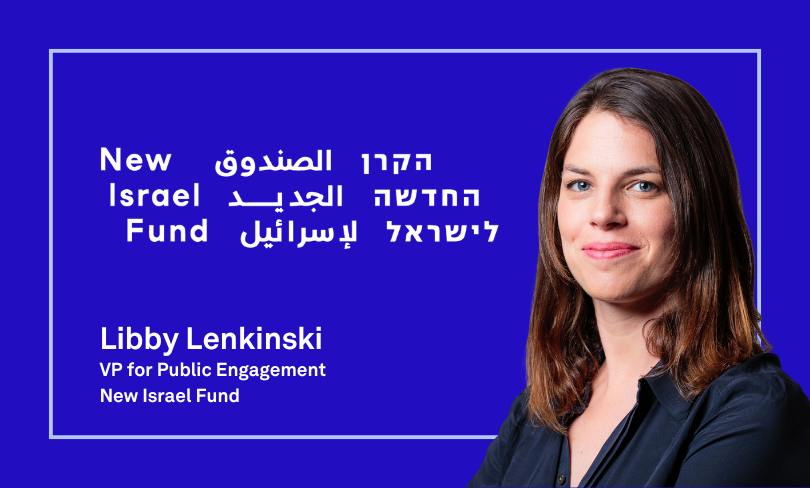
For the last fourteen years, I have served as the New Israel Fund’s Vice President of Public Engagement. You’ve seen me on NIF webinars, at in-person events, in Zoom boxes with artists and activists from across Israel-Palestine. I’ve been your film club host, your translator of complex political dynamics, your conduit to grantees and changemakers on the ground. It has been one of the deepest honors of my life. Because NIF isn’t just a job for me. It’s my home. It’s where I became the kind of activist and cultural strategist I am today.
That’s why I’m writing to share something that feels both tender and thrilling: I’m stepping into a new role—but not away from the work.
I’ve launched Albi—a cultural fund, institute, and lab. It’s independent, but spiritually and strategically adjacent to NIF. The mission is simply to harness the power of culture to shift narratives, spark imagination, and drive change in and about Israel-Palestine.
Albi supports filmmakers, artists, and storytellers—Palestinian and Jewish—who are trying to widen the lens. To challenge the narrative fortress that says this is a zero-sum game. To replace stuckness with political imagination. To create the cultural groundwork for equality, justice, and co-resistance. It’s a creative insurgency, a lighthouse for those telling the stories that aren’t supposed to be told.
So, I am stepping out of my VP role—but I am not going far. Just around the corner, really. I may be leaving my official role at NIF, but my heart—and my politics—will always be rooted here. Albi would not exist without the values, vision, and mentorship I found at NIF. Last week, Haaretz published an article titled “In an Era of Growing Censorship in Israel, This Small Film Fund Is Pushing Back”— that’s Albi. It is a small fund with big goals, one that will never be far from the values-driven world of the New Israel Fund.